
Explainer: The Difference Between Symmetry and Tessellation in Pattern Design
Explainer: The Difference Between Symmetry and Tessellation in Pattern Design
Put a panel of glazed zellige beside a roll of block-printed cotton and both will read as "geometric". Ask what actually holds each one together and the answers split. One depends on symmetry, the other on tessellation, and plenty of everyday patterns depend on both at once. In studios the two words get used as though they were interchangeable, which causes real problems. A brief asking for "a symmetrical tile pattern" can be satisfied in a dozen ways the client never pictured. A print that repeats perfectly can still fail because a mirror line landed where nobody looked.
The distinction in one sentence: symmetry describes the moves that leave a pattern looking unchanged; tessellation describes how shapes cover a surface with no gaps and no overlaps. One is about movement, the other about coverage. The rest is detail.
Symmetry is a set of moves, not a look
Most people hear "symmetry" and think of a mirror: a left side matching a right side. That is only one kind of symmetry. In pattern design, symmetry is the collection of transformations that map a pattern onto itself. If you can slide, turn, flip, or glide the pattern and it lands back on itself perfectly, that move is a symmetry of the pattern.
There are four basic moves worth knowing. They sound technical, but they show up in ordinary design decisions all the time.
- Translation: sliding the motif along a line. A row of polka dots, a brick wall, or a strip of Greek key all use translation. The pattern repeats without turning or flipping.
- Reflection: mirroring across a line. A butterfly is the classic example, but so is a mirrored border on a scarf or a wallpaper where the left half reflects the right.
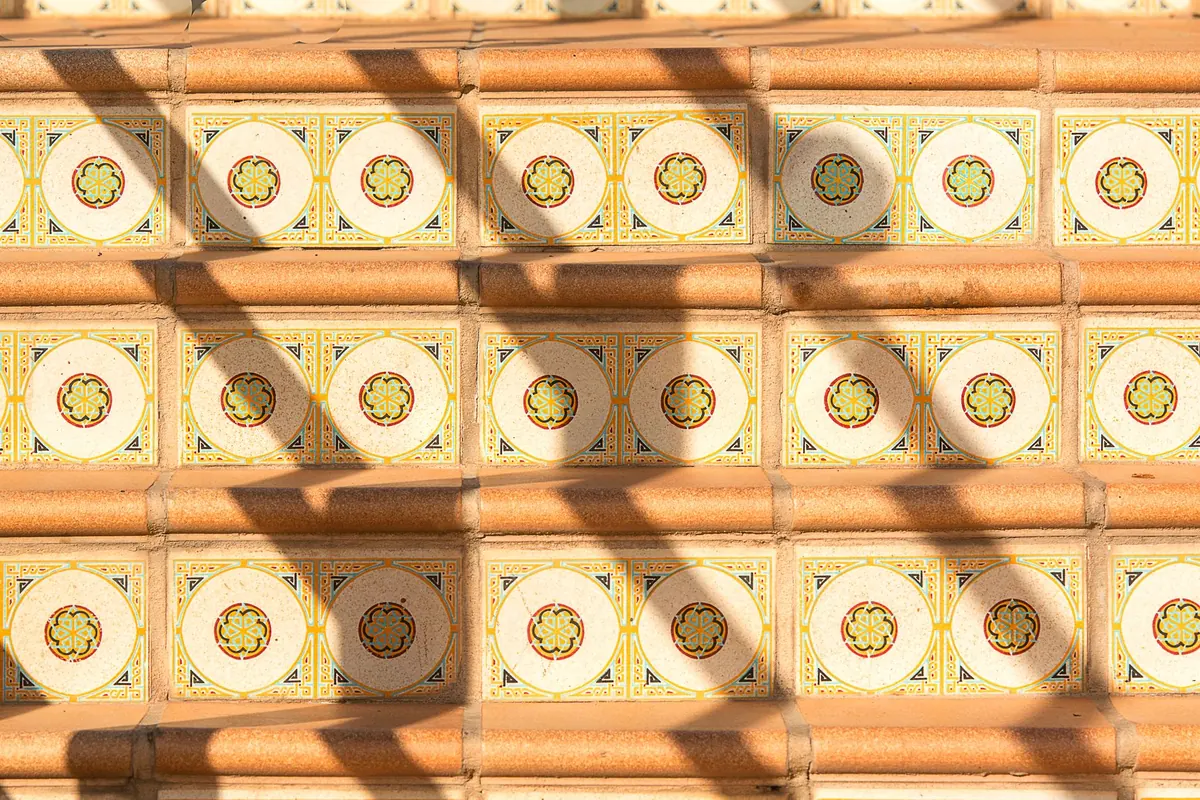
- Rotation: turning around a point. A pinwheel, a six-pointed star, or a zellige tile with a central medallion often has rotational symmetry. The pattern looks the same after a partial turn.
- Glide reflection: sliding and then mirroring. Footprints in sand are the everyday version. Many Celtic knots and some herringbone variations use it too.
Symmetry can exist at different scales. A single motif may have rotational symmetry. A border may have reflection symmetry. A full wallpaper repeat may have translation symmetry across the whole wall. The key is not whether the design looks "balanced" but which moves leave it unchanged.
Tessellation is about coverage, not movement
Tessellation is the geometry of tiling. It asks how shapes fit together to cover a surface with no gaps and no overlaps. A honeycomb is a tessellation of hexagons. A brick wall is a tessellation of rectangles, staggered so the joints do not line up. A square grid is the simplest tessellation of all. Islamic star-and-polygon patterns, Escher's interlocking birds and fish, and many floor mosaics are tessellations too.
Tessellations come in several useful types. A regular tessellation uses one regular polygon repeated, like squares or hexagons. A semi-regular tessellation mixes regular polygons but arranges them so every vertex looks the same. An irregular tessellation uses non-regular shapes, which is where design gets expressive. If one shape does all the tiling, it is monohedral. If the shapes meet edge-to-edge, it is edge-to-edge; if they interlock with stepped or curved edges, it is not.
The important point is that a tessellation can be completely asymmetrical. You can tile a surface with irregular, hand-cut shapes that have no mirror line, no rotation center, and no repeating unit at all. It still tessellates because it covers the surface. Coverage and symmetry are different questions.
Where the two overlap—and where they don't
Many great patterns are both symmetrical and tessellated. A hexagonal honeycomb is a tessellation, and it also has rotational and reflectional symmetry. A traditional zellige panel may be assembled from interlocking tiles that cover the wall without gaps, while the overall composition has mirror lines and rotation points. A seamless textile repeat is usually a tessellation in the practical sense: the printed block must tile across the fabric without gaps or overlaps. If the repeat also mirrors or rotates, it carries symmetry as well.
But the two can separate cleanly. A single snowflake has six-fold rotational symmetry and several mirror lines, yet one snowflake does not cover a surface without gaps. It is symmetrical but not a tessellation until it is repeated in a tiling. Conversely, a jigsaw puzzle is a tessellation of interlocking shapes, but the picture on it may have no symmetry whatsoever. A checkerboard is both: squares tile the plane, and the board has translation, rotation, and reflection symmetry. A staggered brick wall is a tessellation with translation and glide reflection, but it may lack a simple mirror line because the bricks are offset.
This is why saying "symmetrical tile pattern" is not enough. The client may mean a mirrored layout, a radial medallion, or simply a repeat that feels orderly. Each answer leads to a different construction.
Why the confusion causes real problems
In a studio, vague language creates rework. A brief for a "symmetrical tile pattern" might be satisfied by a mirror repeat, a half-drop repeat, a four-way rotational repeat, or a radial rosette. If the designer picks mirror and the client wanted radial, the pattern is technically symmetrical but wrong. A brief for a "tessellated print" might mean interlocking shapes with no background gaps, or it might just mean a seamless repeat with a plain ground between motifs. Those are very different files.
Production makes the stakes higher. A block-printed cotton repeat is a tessellation problem if the motif must interlock across the seam. It is a symmetry problem if the repeat must mirror at the selvage. A ceramic tile layout is a tessellation problem in the grout lines, but a symmetry problem in the visual rhythm. A wallpaper with a large medallion needs precise rotation centers and mirror axes, or the room will feel off even if the repeat is technically seamless.
A quick studio checklist
When a brief uses either word, translate it into specifics before drawing. This checklist can save a week of revisions.
- Define the unit: Is the repeating element a motif, a tile, or a block of several shapes?
- Define the repeat: Is it straight translation, half-drop, brick, mirrored, rotational, or a combination?
- Define the coverage: Must the shapes cover the surface with no gaps and no overlaps, or is a background ground allowed?
- Check the axes: Where are the mirror lines, rotation centers, and glide axes? Mark them on a proof.
- Check the seam: Does the pattern survive the join at the repeat edge? Print or tile a full-scale mockup.
- Name the operations: Write "mirrored left-to-right and repeated every 20 cm" instead of "symmetrical".
A vocabulary that helps clients
Most confusion disappears when you replace abstract terms with observable ones. Instead of "symmetrical", say "mirrored left-to-right", "rotated 90 degrees", "repeating every 20 cm", or "radial around a central medallion." Instead of "tessellated", say "interlocking shapes with no background gaps", "edge-to-edge hexagons", or "a seamless repeat." These phrases describe what the eye will actually see and what the production file must actually do.
It also helps to separate the two questions in conversation. First ask: How does it move? That is symmetry. Then ask: How does it cover? That is tessellation. A pattern can have a rich answer to one and a simple answer to the other.
The mathematics underneath
For designers who want a deeper map, mathematics offers classifications. In the plane, there are exactly 17 wallpaper groups, which describe all possible combinations of translation, rotation, reflection, and glide reflection in a periodic pattern. Tessellations have their own families: regular, semi-regular, and non-periodic. Penrose tiles are a famous non-periodic tessellation with aperiodic order, meaning they tile without gaps but never repeat in a simple translational way.
You do not need to calculate a wallpaper group to design well. But knowing the categories can help you diagnose why a pattern feels static, busy, or unresolved. A missing mirror line, an off-center rotation point, or a tile that almost interlocks can be spotted faster when you know what you are looking for.
The takeaway
Symmetry and tessellation are not synonyms. Symmetry is the set of moves that leave a pattern unchanged. Tessellation is the way shapes cover a surface with no gaps and no overlaps. They often coincide, especially in Islamic geometric patterns, honeycombs, and seamless textile repeats, but each answers a different question. When you brief, specify both: how the pattern moves and how it covers. That is how you get the pattern you pictured, not just a pattern that sounds right in words.
Photo: Jan van der Wolf / Pexels